

Roles & Permissions
Learn how to manage roles in PBX Stats: create, modify, or enable permissions.
A PBX Stats role is a combination of permissions that lets a user perform actions allowed by the selected permissions.
Role creation
To create auser role:
Open Roles
Go to Configuration > Roles.
Create a role
On the Roles Manager page, click Create New Role in the top right corner.

Roles Manager page
Name the role
In the New Role window displayed, specify the name and description for the role.
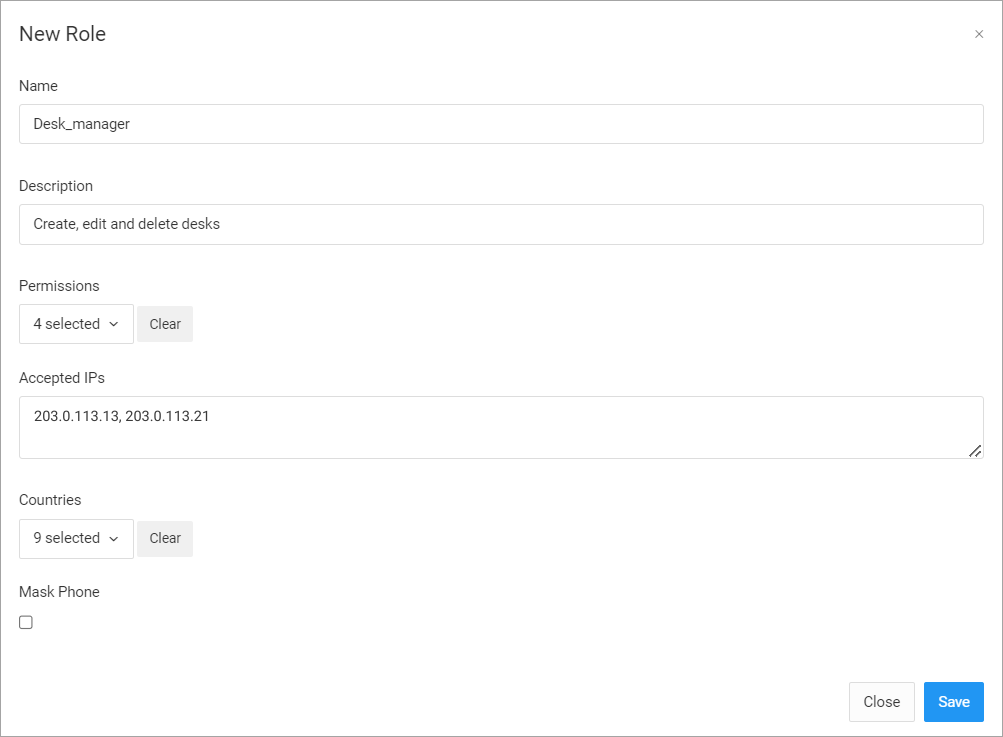
New Role form
Select the permissions
Click in the Permissions field and select the actions the role will be allowed to do.
Add accepted IPs
Add one or more IP addresses in Accepted IPs. Users with this role can access PBX Stats only from those IPs.
Mask phone numbers
Select the Mask Phone check box to use the Phone Number Masking feature for the user assigned this role.
Save the role
Click Save.
The new role will appear in the list of roles.

New role added
To modify settings for a role, click Edit in the Actions column for the needed role.
To remove the role from the list, click Delete.
Role permissions
| Permission Name | Explanation |
|---|---|
| access_api_key | Can access the API key |
| admin | Can access all sections and features of PBX Stats |
| api_docs | Can access PBX Stats API documents |
| can_hangup_call | Can perform call hangup |
| create_agent | Can create agents |
| create_agent_bulk | Can create multiple agents |
| create_desk | Can create desks |
| create_device | Can create Devices |
| create_device_bulk | Can create multiple devices |
| create_outbound_identity | Can create outbound identities |
| create_pause_type | Can create pause types |
| create_role | Can create roles |
| create_scheduled_report | Can create scheduled reports |
| create_shift | Can create shifts |
| create_user | Can create users |
| create_webhook | Can create Scheduled Reports |
| delete_desk | Can delete desks |
| delete_device | Can delete devices |
| delete_outbound_identity | Can delete outbound identities |
| delete_queued_request | Can delete queued requests |
| delete_role | Can delete roles |
| delete_scheduled_report | Can delete scheduled reports |
| delete_shift | Can delete shifts |
| delete_user | Can delete users |
| delete_webhook | Can delete webhooks |
Special permissions
Typical roles in a call center are the manager, the compliance manager, and the administrator.
The manager has permission to manage only the desks to which he/she is assigned.
The compliance manager has access to the CDRs so that he/she can listen to all the call recordings.
The administrator has permission to perform all the actions and settings in the system. However, there are three special permissions:
- show_all_desk_reports
- show_all_desks_realtime
- show_all_desks
The example below explains in detail how special permissions work.
EXAMPLEIn the call center, there are two desks - Desk 1 and Desk 2.
Manager A is assigned to Desk 1, and Manager B is assigned to Desk 2.
Both Manager A and Manager B are subordinate to Manager C.Manager A, except for managing his desk, is responsible for preparing reports on the activity of the whole call center. This is why he is granted a role with show_all_desk_reports permission.
Manager B is in charge of real-time monitoring and must see the current data for all the agents in the call center. So, he is assigned a role with show_all_desks_realtime permission.
Manager C, to supervise Managers A and B, should have access to the desks under their control. He is granted a role with show_all_desks permission.
Updated 4 days ago